
RD3 Alodwan - ردع العدوان (Unannounced)

Specifications

Role: 

Game Designer,

Level Designer

Genre: 

3rd Person Tactical Shooter

Engine: 

Unity

Players: 

2-5 Cooperative

Modes: 

5-Mission campaign,

15-Wave survival

Platform: 

Mobile

Team Size: 

11

Duration: 

1 Year

Year: 

2026

Overview

RD3 Alodwan is a five-player cooperative tactical shooter for mobile, set in Syrian urban environments. Two modes share one combat system: a five-mission campaign where squads commit to stealth infiltration or direct assault, and a fifteen-wave survival mode defending a watchtower in the Aleppo Citadel. Every system was designed against two constraints, a touchscreen and a mid-range phone.
What I Owned

Systems Design
  • Defined the core gameplay systems shared by both modes, combat, camera, cover, movement, health, downed and revival states, scoring, and HUD feedback
  • Designed the five-class system, differentiating classes through weapon loadouts and stat distribution rather than special abilities
  • Specified the four enemy types and their tactical counter-relationships, with encounter-frequency guidance per type
  • Designed the wave-mode resource economy: point rewards per wave tier, store access windows, repair costs scaled to watchtower damage, and item trading rules
  • Proposed and implemented the fifteen-wave horde survival mode
Documentation
  • Authored eight weapon design documents covering stats, effectiveness, penalties, and per-weapon asset requirements for art, audio, and VFX
  • Authored four enemy design documents specifying behavior, threat level, counters, encounter usage, and audio-visual identification cues
  • Wrote NPC specifications for civilians and friendly fighters with testable acceptance criteria per behavior
  • Owned the game design document end to end, and tracked delivery of the sections other disciplines contributed across narrative, art, audio, programming, and UX
Level Design
  • Laid out and blocked out two of the five campaign missions, and designed gameplay encounters and activities across three
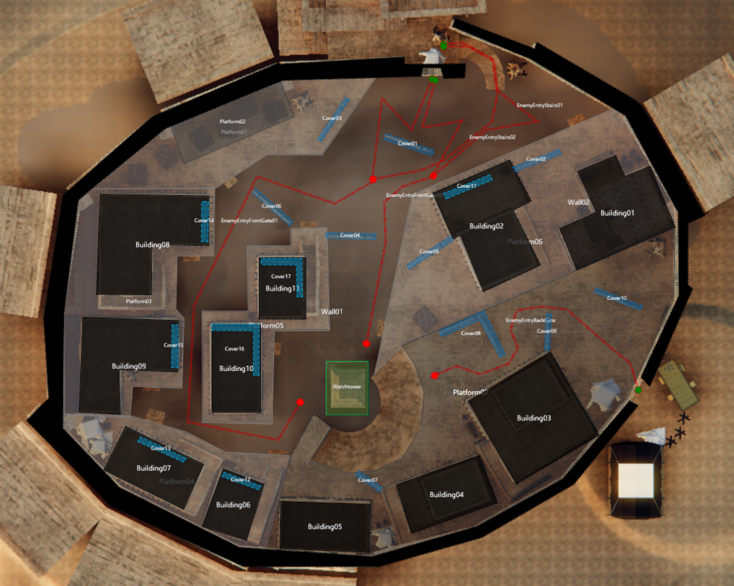
  • Designed the horde-mode arena, spawn points, cover placement, and enemy approach routes converging on the watchtower with every element labeled for programmer handoff
  • Produced annotated top-down layouts marking objectives, enemy placement by type, keys, locked and passcode doors, path blockers, and underground routes
Production
  • Led design across an 11-person team spanning programming, art, and design
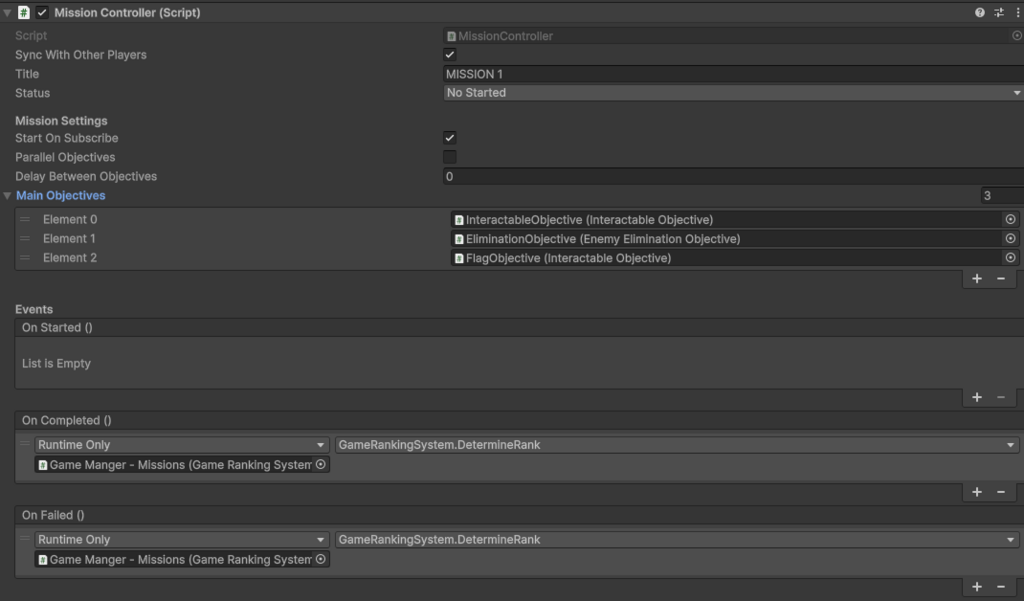
  • Designed and implemented a modular mission objective system, letting objectives be composed per mission without new code
  • Scoped remaining production across five missions and nine concurrent workstreams into a milestone-dated delivery estimate with per-item risk

Design Decisions

  • Cutting mechanics, not adding them. No snap-to-cover, blind fire, vaulting, or leaning. Each costs a button or a gesture on a touchscreen. Cover works by positioning alone, less tactical depth, nothing to learn.
  • Classes without abilities. Five classes separated by loadout and stats, no cooldowns. A Vanguard is a shotgun, a 1500 HP shield, and a movement penalty, class identity comes from how a weapon plays, not from a button.
  • Different death rules for the two modes. Shared combat systems, inverted death rules. Waves respawns you each round unless the whole team is dead; Missions has no checkpoints and permanent death after a two-minute bleed-out.
  • Identification before mechanics. Red beret on the Elite, squared backpack on the RPG Specialist, scope glint on the Sniper, audible charge before a rocket. On a small screen, a threat you can't identify is one you can't prioritize.
  • Horde mode for replayability. A five-mission campaign ends and gives players no reason to reopen the app. A repeatable loop built from existing props, enemies, and weapons cost implementation time rather than new art.

Implementation

Horde Game Mode

Arena Layout

Arena layout. A dedicated arena for the mode, with the watchtower as the defended objective. Enemies enter from three perimeter points: front gate, side stairs, and back lane. Each has a routed path to the tower, so players can't cover everything from one position. Cover and platforms sit along those routes. Weapons, enemies, and most props are reused from the campaign missions.

Buildings, cover, walls, platforms, and spawn nodes all carry explicit names, so programmers and the second level designer work from the same references as the layout doc.

Dev Playtesting Session

Dev playtest, held by me and the lead programmer. Wave 1, watchtower health, next-wave timer and team status visible.
Modular Mission Implementation

Mission Core Loop

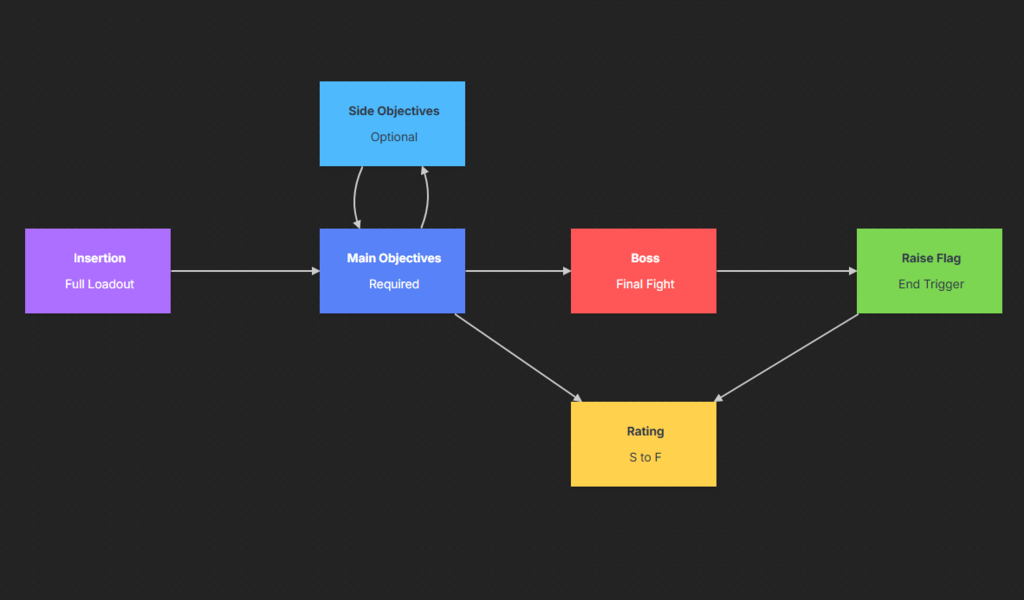
Mission flow. Side objectives sit off the main route and feed the end rating alongside main objective completion.
Mission Controller

Objectives are composed from a shared system rather than scripted per mission, so a designer can assemble a mission without programmer time, and a fix propagates everywhere instead of five times.

What Playtesting Changed

Old blockout against the current art pass
Drag to compare. Left: original scale. Right: current scale.

Mission 1 scale. Playtests showed the military base was too small, players crossed it faster than the mission was pacing for. Scaling it up made room for more encounters and brought it in line with the other missions, so mission length stays consistent across the campaign.